Harry Potter and the Prisoner of Azkaban (8.5/10)
The most significant turning point in the film series -- and the one and only Harry Potter story in which Voldemort doesn’t appear.
Harry Potter and the Prisoner of Azkaban is more “internal” and deals with Harry’s personal sense of loss — and fear. And of course it’s also an abrupt (even jarring) change in tone from the previous films. Whereas Columbus channels Spielberg, Alfonso Cuarron’s approach is more expressionistic and flamboyant, like “Terry Gilliam meets Guillermo Del Toro”. This radically-different style, (plus the jarring change from Richard Harris' Dumbledore to Michael Gambon's), was somewhat off-putting to me in 2004 -- but I confess it's grown on me over the years.
There’s no denying Cuarron is a visual master who renders PoA a visually satiating picture. Michael Seresin’s cinematography is much more expressionistic than the colorful work of John Seale and Roger Pratt (and like the film, plays to the spooky rather than the magical) -- yet Seresin's photography is gorgeous in its own way.
That said, first 15-20 minutes of this movie are definitely clunky. Curron is not as deft a comedy director as Columbus. The Aunt Marge inflation sequence is too slow and labored, and the "Knight Bus" sequence is too frenetic. The “Monster Book” scene is just unfunny (and also unnecessary). But the film really gets in gear once Harry meets-up with Ron and Hermione, and flows really well from there on in; in fact PoA is arguably better-paced than the Columbus movies. It is also a very emotionally-resonant film — there is great chemistry between the actors in PoA, especially in the scenes between Harry and Lupin, and those with Sirius Black, and Harry's character experiences the most personal growth in this particular story.
I do love Michael Gambon as an actor, but I don't feel he was the best choice to take over from Richard Harris. I'm still irked at Cuarron for ignoring the wishes of Harris' family, who begged him to cast Peter O'Toole (who would have been perfect). Barring O'Toole, my dream choice would have been Sean Connery, though I'd love for it to have gone to Jeremy Irons, and would have been perfectly happy with Ben Kingsley or Derek Jacobi.
As far as the music, I originally found John Williams’ score a disappointment, as he abandoned all his themes from the previous films, (save for a few brief appearances of “Hedwig’s Theme”, and one quote of "Nimbus 2000"), plus his score for PoA was much-more somber and dissonant. But over time, I've come around to the fact that most of his original themes weren't really applicable to the tone of PoA. The "Double Trouble" and "Window to the Past" themes are better suited to this more pensive and melancholy film -- and they are among Williams' most impressive work. I suppose it is similar to the way his music for Star Wars expressed that film's sense of heroism and adventure, but he had to take similarly darker turn to suit The Empire Strikes Back.
I always suspected Williams was far from Alfonso Curron’s first choice to score PoA, and that the he was more or less imposed on the director (Cuarron being more of an “arthouse” director — and those types have tended to sneer at Williams). I was thus very surprised to learn from Tim Greiving’s book that Curron was actually a huge fan of Williams — all the way back to the Irwin Allen TV shows he watched as a kid. Moreover Cuarron was also, remarkably, a follower of Williams’ concert music. Greiving's book also revealed that, that despite Cuarron's desire to "veer into the shadows", the director credits John Williams with balancing the film by providing a sense of optimism.
But for me there is a sadness hanging over this score -- as it was John Williams’ final Harry Potter film. The series was never the same (nor as good) without him. John Williams brought so much character to those first three movies. Despite his reputation for big and portentous music, his work is often more often subtle, introspective and nuanced, especially in PoA. His music also bursts with enormous cleverness, and provides much of the movie's sense of wonder. I also regard PoA as Williams' last truly great score.
rate the last movie you saw
-
Paul MacLean

- Posts: 7846
- Joined: Sat Oct 09, 2004 10:26 pm
- Location: New York
Re: rate the last movie you saw
Last edited by Paul MacLean on Sun Dec 28, 2025 10:42 pm, edited 3 times in total.
-
Eric Paddon
- Posts: 9250
- Joined: Sun Apr 10, 2005 5:49 pm
Re: rate the last movie you saw
Home Alone (1990) 9 of 10
=I saw this theatrically and I know I came away liking it. But I think I only saw it one time on video afterwards and honestly it may have been 30 years now since I saw it. But after indulging "Santa Claus" for the first time I figured I should reacquaint myself with this and right now I feel like I've been gypping myself after all these years, but then again, maybe it was the fact that it had been so long since I'd seen it that made me truly appreciate it on a level that wasn't there when I was just pleasantly amused as a 21 year old viewer in 1990. Because it had been so long, I'd forgotten the specifics of the comedy in warding off the crooks and as a result I laughed uproariously which I don't often do when watching a film by myself. I was pleased and moved by the fact that the religious side of Christmas was treated respectfully in that Kevin hides safely in a Nativity scene and the scene in the Church is done solemnly and respectfully and serves as a "turning point" if you will that I found nice. And honestly, for the first time in I don't know how long I found myself crying at the end when the reunion between mother and son takes place. Maybe the fact that it's been ten years now since the last Christmas my mother was alive for (and when she had only two months to live) and the fact that family Christmas gatherings are now a thing of the past in my life that this struck an emotional chord with me that didn't exist in 1990 and maybe wouldn't have been there if this film had become a regular viewing habit for me over the decades. At any rate, I'm glad I've seen it again and that also Williams score is now burned into me along with the other classic Williams music.
-I will admit after having also seen "Planes, Trains And Automobiles" the other day too (a film I have seen many times over the years), I couldn't help but think maybe Candy's cameo should have been him playing Del Griffith again if only because it's basically the same character for all intents and purposes!
-Because of my emotional reaction to this, there is NO way I can handle tackling "Home Alone 2" at this point in time (never saw it before but it's in the Blu-Ray set I picked up to see the first movie again). I feel like I'd cheapen the special reaction I felt to this film.
=I saw this theatrically and I know I came away liking it. But I think I only saw it one time on video afterwards and honestly it may have been 30 years now since I saw it. But after indulging "Santa Claus" for the first time I figured I should reacquaint myself with this and right now I feel like I've been gypping myself after all these years, but then again, maybe it was the fact that it had been so long since I'd seen it that made me truly appreciate it on a level that wasn't there when I was just pleasantly amused as a 21 year old viewer in 1990. Because it had been so long, I'd forgotten the specifics of the comedy in warding off the crooks and as a result I laughed uproariously which I don't often do when watching a film by myself. I was pleased and moved by the fact that the religious side of Christmas was treated respectfully in that Kevin hides safely in a Nativity scene and the scene in the Church is done solemnly and respectfully and serves as a "turning point" if you will that I found nice. And honestly, for the first time in I don't know how long I found myself crying at the end when the reunion between mother and son takes place. Maybe the fact that it's been ten years now since the last Christmas my mother was alive for (and when she had only two months to live) and the fact that family Christmas gatherings are now a thing of the past in my life that this struck an emotional chord with me that didn't exist in 1990 and maybe wouldn't have been there if this film had become a regular viewing habit for me over the decades. At any rate, I'm glad I've seen it again and that also Williams score is now burned into me along with the other classic Williams music.
-I will admit after having also seen "Planes, Trains And Automobiles" the other day too (a film I have seen many times over the years), I couldn't help but think maybe Candy's cameo should have been him playing Del Griffith again if only because it's basically the same character for all intents and purposes!
-Because of my emotional reaction to this, there is NO way I can handle tackling "Home Alone 2" at this point in time (never saw it before but it's in the Blu-Ray set I picked up to see the first movie again). I feel like I'd cheapen the special reaction I felt to this film.
-
AndyDursin

- Posts: 36631
- Joined: Tue Oct 05, 2004 8:45 pm
- Location: RI
Re: rate the last movie you saw
I can understand that so it might be worthwhile to let it breathe -- yet the sequel is very well made, by all the same creative people essentially. I think you would especially appreciate how it makes NYC into this color-soaked sort of kids storybook land. The locale switch was smart -- it's kind of a love letter to the city at that time -- and Williams' score has some lovely new material.-Because of my emotional reaction to this, there is NO way I can handle tackling "Home Alone 2" at this point in time (never saw it before but it's in the Blu-Ray set I picked up to see the first movie again). I feel like I'd cheapen the special reaction I felt to this film.
That said, it's a recycle -- albeit a good one -- with the exception of the old man nextdoor being swapped out for a homeless woman who lives in Central Park. That always felt hackneyed to me, but otherwise, it's a first-class sequel, even if I (much) prefer the original.
-
Paul MacLean
- Posts: 7846
- Joined: Sat Oct 09, 2004 10:26 pm
- Location: New York
Re: rate the last movie you saw
Harry Potter and the Goblet of Fire (7/10)
Mike Newell continues Alfonso Cuarron’s “darker” interpretation of the material (as well as the more expressionistic lighting style), yet offers a lighter touch in places.
In a lot of ways this is the least-successful adaptation of any of Rowling’s stories. Goblet of Fire is a massive book, and the script delivers a very stripped-down version.
Newell resisted WB’s idea of making GOF into two movies as, in his words “there was enough incident for two movies but not enough story”.
Still, the story and the characters remain compelling, and as the saying goes, "the plot thickens". Plus GOF also explores budding adolescence, as the boys and girls start noticing each other in new and different ways (this makes for some of the most interesting -- and bittersweet -- moments in the film). The character development -- not just the boy/girl tensions, but Harry and Ron's falling-out -- helps keep things fresh, and prevents the story from becoming "more of the same".
Yet GOF still feels insufficiently satisfying. The tone of the film is also uneven -- just moments after a murdered student's funeral, Ron Weasley jokes “Do you think we’ll ever have a quiet year at Hogwarts?”
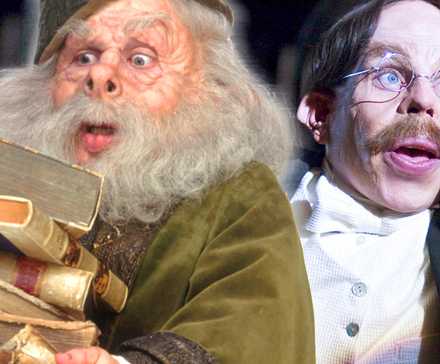
But Newell's biggest blunder was his mistaking Warwick Davis' choral conductor in Prisoner of Azkaban for the character of Professor Flitwick (played by Davis in films one and two). Newell thus puts Professor Flitwick in the hair, make-up and costume of the conductor (in lieu of Flitwick's robe and long beard) resulting in the series' biggest continuity gaffe.
Mike Newell is a gifted journeyman director -- but he's not Chris Columbus or Alfonso Cuarron. He doesn't bring a strong point of view to the material as his predecessors did. He does draw on his experiences as a former British boarding school student, but this actually proves a detriment -- his attempt to show that school headmasters can be "scary" totally contradicts the character of Professor Dumbledore (and more to the point, the way J.K. Rowling wrote this actual scene)...
On the other hand, the above scene is gorgeously shot, and Roget Pratt's photography for GOF results in some of the most arresting imagery of the entire series.
The resurrection of Voldemort (played to chilling perfection by Ralph Fiennes) is also tremendously effective and by far the best scene in the movie (too bad it’s only a few minutes long). Harry’s tangle with the dragon also looks incredible, and is one of the best-rendered effects sequences of the entire series.
I must say I dislike Patrick Doyle’s score, which spoils much of the film’s potential appeal. Despite a promising main title (which integrates Williams’ “Hedwig’s Theme”), the remainder of the score is at best perfunctory. Musically speaking, it’s fair (though it sounds like it was created by someone noodling on a keyboard — which it probably was). Dramatically however, I find it insubstantial, with little dramatic punch, and it doesn't do much to enhance or uplift the drama.
And it’s not that I resent someone other than John Williams getting the assignment. There were a myriad of composers I’d have loved to fill-in for Williams, all of them experienced in macabre fantasy, and all of them on major studio radar at the time — Danny Elfman, James Horner, George Fenton, Rachel Portman, Trevor Jones, and frequent Newell collaborator Richard Rodney Bennett (why didn’t he do this?).
That awful song over the end credits is just salt in the wound. John Williams wanted to score this film — I recall reading a quote from him in 2004 that “Goblet and Fire is definitely in my future”. Unfortunately, it seems Munich and Memoirs of a Geisha got in the way.
Mike Newell continues Alfonso Cuarron’s “darker” interpretation of the material (as well as the more expressionistic lighting style), yet offers a lighter touch in places.
In a lot of ways this is the least-successful adaptation of any of Rowling’s stories. Goblet of Fire is a massive book, and the script delivers a very stripped-down version.
Newell resisted WB’s idea of making GOF into two movies as, in his words “there was enough incident for two movies but not enough story”.
Still, the story and the characters remain compelling, and as the saying goes, "the plot thickens". Plus GOF also explores budding adolescence, as the boys and girls start noticing each other in new and different ways (this makes for some of the most interesting -- and bittersweet -- moments in the film). The character development -- not just the boy/girl tensions, but Harry and Ron's falling-out -- helps keep things fresh, and prevents the story from becoming "more of the same".
Yet GOF still feels insufficiently satisfying. The tone of the film is also uneven -- just moments after a murdered student's funeral, Ron Weasley jokes “Do you think we’ll ever have a quiet year at Hogwarts?”
But Newell's biggest blunder was his mistaking Warwick Davis' choral conductor in Prisoner of Azkaban for the character of Professor Flitwick (played by Davis in films one and two). Newell thus puts Professor Flitwick in the hair, make-up and costume of the conductor (in lieu of Flitwick's robe and long beard) resulting in the series' biggest continuity gaffe.
Mike Newell is a gifted journeyman director -- but he's not Chris Columbus or Alfonso Cuarron. He doesn't bring a strong point of view to the material as his predecessors did. He does draw on his experiences as a former British boarding school student, but this actually proves a detriment -- his attempt to show that school headmasters can be "scary" totally contradicts the character of Professor Dumbledore (and more to the point, the way J.K. Rowling wrote this actual scene)...
On the other hand, the above scene is gorgeously shot, and Roget Pratt's photography for GOF results in some of the most arresting imagery of the entire series.
The resurrection of Voldemort (played to chilling perfection by Ralph Fiennes) is also tremendously effective and by far the best scene in the movie (too bad it’s only a few minutes long). Harry’s tangle with the dragon also looks incredible, and is one of the best-rendered effects sequences of the entire series.
I must say I dislike Patrick Doyle’s score, which spoils much of the film’s potential appeal. Despite a promising main title (which integrates Williams’ “Hedwig’s Theme”), the remainder of the score is at best perfunctory. Musically speaking, it’s fair (though it sounds like it was created by someone noodling on a keyboard — which it probably was). Dramatically however, I find it insubstantial, with little dramatic punch, and it doesn't do much to enhance or uplift the drama.
And it’s not that I resent someone other than John Williams getting the assignment. There were a myriad of composers I’d have loved to fill-in for Williams, all of them experienced in macabre fantasy, and all of them on major studio radar at the time — Danny Elfman, James Horner, George Fenton, Rachel Portman, Trevor Jones, and frequent Newell collaborator Richard Rodney Bennett (why didn’t he do this?).
That awful song over the end credits is just salt in the wound. John Williams wanted to score this film — I recall reading a quote from him in 2004 that “Goblet and Fire is definitely in my future”. Unfortunately, it seems Munich and Memoirs of a Geisha got in the way.
Last edited by Paul MacLean on Sun Dec 28, 2025 10:34 pm, edited 1 time in total.
-
Paul MacLean
- Posts: 7846
- Joined: Sat Oct 09, 2004 10:26 pm
- Location: New York
Re: rate the last movie you saw
Further on the church scene, a friend of mine posted this on Facebook earlier today.Eric Paddon wrote: Thu Dec 18, 2025 10:45 am I was pleased and moved by the fact that the religious side of Christmas was treated respectfully in that Kevin hides safely in a Nativity scene and the scene in the Church is done solemnly and respectfully and serves as a "turning point" if you will that I found nice.
Wow...
-
Eric Paddon
- Posts: 9250
- Joined: Sun Apr 10, 2005 5:49 pm
Re: rate the last movie you saw
Troll (1986) 5 of 10
-I had seen it once before years ago, and for me the interest in this film can be summed up in its dual Battlestar Galactica connections with Noah Hathaway in the lead and Anne Lockhart putting in a late appearance in the film as the younger version of mother June Lockhart's witch. Anytime Galactica alum reunite for anything is a special moment (even if Noah and Anne only interact at the very end of the movie). The film itself I knew was bizarre but my goodness, I was so unaware of the fact that this is likely where Rowling took the name "Harry Potter" from in creating her franchise (that I have never read or seen). And what's really hilarious is how I forgot Michael Moriarty was the father in this, and in all the intervening decades since I last saw this film, I had seen him on "Law And Order" so many times and to see him with the SAME mannerisms and delivery he'd use a few years later as DA Ben Stone while acting goofy just had me rolling on the floor. For me it's even more surreally funny than it is for Seinfeld fans to see Julia Louis-Dreyfus turned into a naked wood-nymph.
-I'm not going to see "Troll 2" which comes in the same Blu-Ray set because it has none of the cast of the first and I've heard about how bad it is.
-I had seen it once before years ago, and for me the interest in this film can be summed up in its dual Battlestar Galactica connections with Noah Hathaway in the lead and Anne Lockhart putting in a late appearance in the film as the younger version of mother June Lockhart's witch. Anytime Galactica alum reunite for anything is a special moment (even if Noah and Anne only interact at the very end of the movie). The film itself I knew was bizarre but my goodness, I was so unaware of the fact that this is likely where Rowling took the name "Harry Potter" from in creating her franchise (that I have never read or seen). And what's really hilarious is how I forgot Michael Moriarty was the father in this, and in all the intervening decades since I last saw this film, I had seen him on "Law And Order" so many times and to see him with the SAME mannerisms and delivery he'd use a few years later as DA Ben Stone while acting goofy just had me rolling on the floor. For me it's even more surreally funny than it is for Seinfeld fans to see Julia Louis-Dreyfus turned into a naked wood-nymph.
-I'm not going to see "Troll 2" which comes in the same Blu-Ray set because it has none of the cast of the first and I've heard about how bad it is.
-
Paul MacLean
- Posts: 7846
- Joined: Sat Oct 09, 2004 10:26 pm
- Location: New York
Re: rate the last movie you saw
You're missing out!Eric Paddon wrote: Fri Dec 26, 2025 7:32 pm I was so unaware of the fact that this is likely where Rowling took the name "Harry Potter" from in creating her franchise (that I have never read or seen).
In any case, I'm inclined to doubt J.K. Rowling bothered to watch a Charlie Band movie; if she did, I'm sure she'd have chosen a different name (surely wishing to distance herself from this movie)!

I rented Troll back in the 80s, because I wanted to hear Richard Band's score, which had gotten a glowing review in CinemaScore Magazine -- the reviewer even compared it to The Dark Crystal. I was set to order the soundtrack based on that review; I just wanted to hear it first to be safe. Good thing I waited. It's a decent score...but like The Dark Crystal? Not really!
Oddly enough I would-up working on one of Charlie Band's movies a number of years later after moving to LA (which Richard also scored).
-
Eric Paddon
- Posts: 9250
- Joined: Sun Apr 10, 2005 5:49 pm
Re: rate the last movie you saw
With some franchises I'm at a stage of life where it's just too late to get started.Paul MacLean wrote: Fri Dec 26, 2025 10:28 pmYou're missing out!Eric Paddon wrote: Fri Dec 26, 2025 7:32 pm I was so unaware of the fact that this is likely where Rowling took the name "Harry Potter" from in creating her franchise (that I have never read or seen).
 And honestly, the only reason like I said that made me pick this film up is because of who was in it, not what it was about as movies about trolls, elves and that kind of fantasy stuff has never been my cup of tea (only in the last couple years did I finally see "Legend" which I couldn't connect to. I still haven't seen "Dark Crystal" and others of that type).
-
Paul MacLean
- Posts: 7846
- Joined: Sat Oct 09, 2004 10:26 pm
- Location: New York
Re: rate the last movie you saw
Harry Potter is much-better than Legend, believe me!Eric Paddon wrote: Sat Dec 27, 2025 2:53 pm With some franchises I'm at a stage of life where it's just too late to get started.
 Legend is a gorgeous-looking but relatively simplistic pastiche of classic fairy tales, whereas Harry Potter is a "portal fantasy" -- i.e. characters journey into another word (or more accurately an invisible world that is all around us which we can't see). The characters in Harry Potter are very believable and three-dimensional, and the plotting very complex and clever. There is also a lot of very funny humor in Potter (John Cleese cameos as ghost in a couple of the films).
Although it is isn't a Christian allegory, there is a lot of C.S. Lewis influence on Harry Potter (scripture even figures into the final book). Despite the Evangelical hysteria over their "glorifying witchcraft" the stories endorse Judeo-Christian ideas of good and evil, selflessness, sticking up for others, and make a lot of substantial observations about life, family, friendship, etc., and (to quote Professor Dumbledore) the need to "choose between what is right, and what is easy".
-
Paul MacLean
- Posts: 7846
- Joined: Sat Oct 09, 2004 10:26 pm
- Location: New York
Re: rate the last movie you saw
Continuing with our Hogwarts education...
Harry Potter and the Order of the Phoenix (Story: 8.5/10 - Adaptation: 7/10)
Rowling’s stories remain as imaginative as ever, and the character arcs become even more compelling. It’s too bad the cinematic execution here doesn’t measure-up to the early films. David Yates is a very good director, but he lacks the visual panache of Chris Columbus and Alfonso Cuarron (or even Mike Newell). That said, I think he delivers a more satisfying picture than Newell did. Dramatically, I find OOTP stronger than Goblet of Fire, and Yates is better at creating dramatic tension.
On the other hand, this film lacks the scope, visual flair and “sense of wonder” which pervaded the Columbus films. That nostalgic, “Dickensian” look of the wizarding world’s costumes is likewise gone -- the throngs of extras in the Ministry of Magic look more like used car salesmen from the 1960s. The enchanted character of Hogwarts itself is likewise diminished — other than the Room of Requirements, there is no trace of the hidden passages, secret vaults, magic mirrors, mischievous ghosts, and peripheral garnishings which lent the earlier movies so much character. Likewise, out are the likes of Seale, Pratt and Seresin (each among the best cinematographers of all time if you ask me). Instead we have Slowamir Idziak — a fine cameraman — but not in league with his predecessors.
The change in visual style is best summed-up by these two scenes…
A trial at the Ministry of Magic in The Goblet of Fire:

A trial at the Ministry of Magic in The Order of the Phoenix:
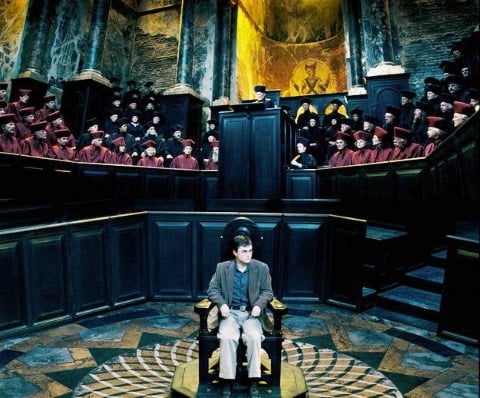
Still this movie is better than I remembered — and quite a breath of fresh air after the awkward and costive Goblet of Fire. Newell is certainly the better visual stylist, but Yates tells the story with more clarity and economy.
There really are some fabulous sequences in OOTP — particularly the scene where Fred and George ditch Hogwarts in a literal blaze of glory. Imelda Staunton is caustically despicable as the soft-spoken but sadistic Delores Umbridge. The whole climax in the Ministry of Magic (especially the fight between Dumbledore and Voldemort) is genuinely thrilling.
Harry also suffers the most in this one, tormented by visitations of the Dark Lord, leaving him a troubled, angry adolescent — more Jim Stark than David Copperfield. One could almost title this movie Wizard Without A Cause.
Nicholas Hooper’s score is very good, and better than I remembered. It is more in sync with the style of John Williams (particularly his bouncy, pompous cue for the Professor Umbridge montage). But although very good, this movie needed a great score. Hooper is not John Williams (of course nobody is) one wishes the producers / Warner Bros. had solicited some of the truly great composers who were writing at that time.
But it’s clear by this point the studio didn’t want to spend money on top people. Yates, Idziak, Hooper -- all capable and gifted artists, but not in league with the their counterparts in the first three films. All of this contributes to a movie that, despite a terrific story and cast, feels “less-than-special”, almost like a TV movie, or more accurately (since we’re five segments into the series) “this week’s episode”.
Harry Potter and the Order of the Phoenix (Story: 8.5/10 - Adaptation: 7/10)
Rowling’s stories remain as imaginative as ever, and the character arcs become even more compelling. It’s too bad the cinematic execution here doesn’t measure-up to the early films. David Yates is a very good director, but he lacks the visual panache of Chris Columbus and Alfonso Cuarron (or even Mike Newell). That said, I think he delivers a more satisfying picture than Newell did. Dramatically, I find OOTP stronger than Goblet of Fire, and Yates is better at creating dramatic tension.
On the other hand, this film lacks the scope, visual flair and “sense of wonder” which pervaded the Columbus films. That nostalgic, “Dickensian” look of the wizarding world’s costumes is likewise gone -- the throngs of extras in the Ministry of Magic look more like used car salesmen from the 1960s. The enchanted character of Hogwarts itself is likewise diminished — other than the Room of Requirements, there is no trace of the hidden passages, secret vaults, magic mirrors, mischievous ghosts, and peripheral garnishings which lent the earlier movies so much character. Likewise, out are the likes of Seale, Pratt and Seresin (each among the best cinematographers of all time if you ask me). Instead we have Slowamir Idziak — a fine cameraman — but not in league with his predecessors.
The change in visual style is best summed-up by these two scenes…
A trial at the Ministry of Magic in The Goblet of Fire:
A trial at the Ministry of Magic in The Order of the Phoenix:
Still this movie is better than I remembered — and quite a breath of fresh air after the awkward and costive Goblet of Fire. Newell is certainly the better visual stylist, but Yates tells the story with more clarity and economy.
There really are some fabulous sequences in OOTP — particularly the scene where Fred and George ditch Hogwarts in a literal blaze of glory. Imelda Staunton is caustically despicable as the soft-spoken but sadistic Delores Umbridge. The whole climax in the Ministry of Magic (especially the fight between Dumbledore and Voldemort) is genuinely thrilling.
Harry also suffers the most in this one, tormented by visitations of the Dark Lord, leaving him a troubled, angry adolescent — more Jim Stark than David Copperfield. One could almost title this movie Wizard Without A Cause.
Nicholas Hooper’s score is very good, and better than I remembered. It is more in sync with the style of John Williams (particularly his bouncy, pompous cue for the Professor Umbridge montage). But although very good, this movie needed a great score. Hooper is not John Williams (of course nobody is) one wishes the producers / Warner Bros. had solicited some of the truly great composers who were writing at that time.
But it’s clear by this point the studio didn’t want to spend money on top people. Yates, Idziak, Hooper -- all capable and gifted artists, but not in league with the their counterparts in the first three films. All of this contributes to a movie that, despite a terrific story and cast, feels “less-than-special”, almost like a TV movie, or more accurately (since we’re five segments into the series) “this week’s episode”.
-
Paul MacLean
- Posts: 7846
- Joined: Sat Oct 09, 2004 10:26 pm
- Location: New York
Re: rate the last movie you saw
Gandhi (8.5/10)
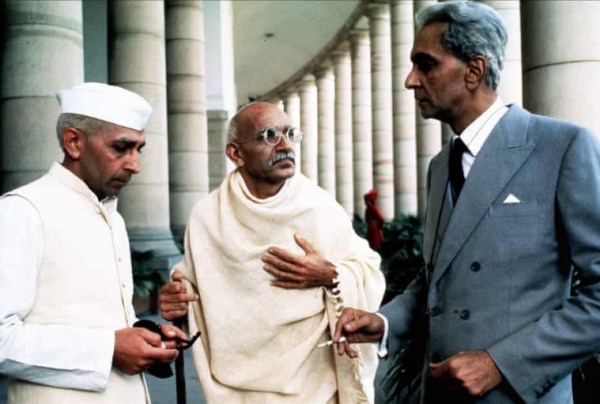
The last time I watched this film was on VHS -- not the best way to experience a production of this scale. Over forty years on, Richard Attenborough's film holds-up as both informative biopic and impressive drama. An adaptation of Gandhi's life was originally supposed to have been made by David Lean with Sam Spiegel in the early 1960s (with Alec Guinness in the title role), but they decided to make Lawrence of Arabia instead. Later in the 60s, Attenborough tried to get a Gandhi project going, with him producing and playing the title role. He offered Lean the job of directing but their collaboration never came to fruition.
The story is best-summed-up in the words of Edward R. Murrow (played by Shane Rimmer in the film) who describes "a private man without wealth, without property, without official title or office. He was was not a commander of great armies nor ruler of vast lands. He could boast no scientific achievements or artistic gift", yet he "led his country to freedom".
I'm aware of the controversy surrounding the opinions of Mohandas K. Gandhi which he expressed earlier in life, but there is no denying his defining accomplishment: the secession of a key nation under the dominion of the largest empire on Earth -- through passive resistance. I also appreciate that the film depicts the seeds of conflict sown by Muhammad Ali Jinnah, whose demands for the Muslim state of Pakistan led to ongoing territorial skirmishes (which persist to this day).
Ben Kingsley gives what is probably still his greatest performance, and I'm hard-pressed to think of anyone better suited to the role (John Hurt was seriously considered for the part -- and I love John Hurt -- but thank God that didn't happen!). Kingsley totally carries this film, and although a younger unknown at the time, holds his own opposite some of the greatest performers of the 20th century, which brings me to one of the films' most impressive attributes -- the cast. Happily there is no "brown face" at work in this picture (Kingsley's birth name is Krishna Bhanji by the way), and it features venerable Indian actors like Saeed Jaffrey, Roshan Seth and Amrish Puri. Luminaries of English stage and screen abound, such as John Mills, John Gielgud, Trevor Howard and Ian Charleson, along with several unknowns who would achieve fame later in their careers -- John Ratzenberger, Bernard Hill, Nigel Hawthorne, Richard Griffiths and a young kid named Daniel Day-Lewis. Americans Martin Sheen and Candice Bergen round-out the impressive band of players. I suspect the better-known actors were cast in order to raise money for the film (a strategy used to bankroll Attenborough's A Bridge Too Far), but that doesn't take away from their performances, which (albeit brief in some cases) are credible, and often powerful.
Enlisting Ravi Shankar to compose the score lends tremendous authenticity, while George Fenton tackles the moments requiring more traditional dramatic scoring. Fenton is himself an accomplished scholar and performer of Indian music (having played on Maurice Jarre's score for The Man Who Would be King), and their collaboration forges an effective musical backdrop invoking both the Raj and native culture.
The camerawork of Billy Williams and Ronnie Taylor is gorgeously lensed and lit -- but, well, Attenborough doesn't usually give them the most arresting images at which to point the camera. And that brings me to what I feel in lacking in this movie -- the type of striking, indelible imagery you expect from a big-budget epic.
Richard Attenborough was a wonderful director, with an impressive and eclectic filmography including Magic, Cry Freedom, Shadowlands, Chaplin, A Chorus Line and my personal favorite of his films, the highly-underrated Grey Owl. That's a versatile director! But Gandhi's story is one of the most compelling of the 20th Century, and one would hope (even expect) a film adaptation of his life to number among the great screen epics of all time. Gandhi is an excellent film -- but unfortunately falls shy of true greatness.
The film looks good, no question. But compare it to David Lean's A Passage to India -- which is bursting with striking, indelible images, and is so much more atmospheric than Attenborough's film. And despite being fiction and a "smaller" story, A Passage to India actually has more scope and is ultimately the more captivating experience. As such it is shame Lean didn't get to make Gandhi (especially as it was a dream project of his).
In any case, Attenborough's Gandhi remains a fine film, and tells a story everyone ought to know -- and tells it very well. Mohandas K. Gandhi was a highly-influential figure -- one beyond the borders of his native country -- whose strategy of passive resistance inspired Martin Luther King, Jr. (the Civil Rights movement in America would probably have been more violent and bloody were it not for Gandhi's influence on Dr. King).
This film was also noteworthy as it began the trend of British and American productions set in India over the next several years -- not just A Passage to India, but Octopussy, Indiana Jones and the Temple of Doom and The Deceivers, as well as television miniseries like The Far Pavilions, Mountbatten: The Last Viceroy and The Jewell in the Crown (which was also scored by George Fenton).
The last time I watched this film was on VHS -- not the best way to experience a production of this scale. Over forty years on, Richard Attenborough's film holds-up as both informative biopic and impressive drama. An adaptation of Gandhi's life was originally supposed to have been made by David Lean with Sam Spiegel in the early 1960s (with Alec Guinness in the title role), but they decided to make Lawrence of Arabia instead. Later in the 60s, Attenborough tried to get a Gandhi project going, with him producing and playing the title role. He offered Lean the job of directing but their collaboration never came to fruition.
The story is best-summed-up in the words of Edward R. Murrow (played by Shane Rimmer in the film) who describes "a private man without wealth, without property, without official title or office. He was was not a commander of great armies nor ruler of vast lands. He could boast no scientific achievements or artistic gift", yet he "led his country to freedom".
I'm aware of the controversy surrounding the opinions of Mohandas K. Gandhi which he expressed earlier in life, but there is no denying his defining accomplishment: the secession of a key nation under the dominion of the largest empire on Earth -- through passive resistance. I also appreciate that the film depicts the seeds of conflict sown by Muhammad Ali Jinnah, whose demands for the Muslim state of Pakistan led to ongoing territorial skirmishes (which persist to this day).
Ben Kingsley gives what is probably still his greatest performance, and I'm hard-pressed to think of anyone better suited to the role (John Hurt was seriously considered for the part -- and I love John Hurt -- but thank God that didn't happen!). Kingsley totally carries this film, and although a younger unknown at the time, holds his own opposite some of the greatest performers of the 20th century, which brings me to one of the films' most impressive attributes -- the cast. Happily there is no "brown face" at work in this picture (Kingsley's birth name is Krishna Bhanji by the way), and it features venerable Indian actors like Saeed Jaffrey, Roshan Seth and Amrish Puri. Luminaries of English stage and screen abound, such as John Mills, John Gielgud, Trevor Howard and Ian Charleson, along with several unknowns who would achieve fame later in their careers -- John Ratzenberger, Bernard Hill, Nigel Hawthorne, Richard Griffiths and a young kid named Daniel Day-Lewis. Americans Martin Sheen and Candice Bergen round-out the impressive band of players. I suspect the better-known actors were cast in order to raise money for the film (a strategy used to bankroll Attenborough's A Bridge Too Far), but that doesn't take away from their performances, which (albeit brief in some cases) are credible, and often powerful.
Enlisting Ravi Shankar to compose the score lends tremendous authenticity, while George Fenton tackles the moments requiring more traditional dramatic scoring. Fenton is himself an accomplished scholar and performer of Indian music (having played on Maurice Jarre's score for The Man Who Would be King), and their collaboration forges an effective musical backdrop invoking both the Raj and native culture.
The camerawork of Billy Williams and Ronnie Taylor is gorgeously lensed and lit -- but, well, Attenborough doesn't usually give them the most arresting images at which to point the camera. And that brings me to what I feel in lacking in this movie -- the type of striking, indelible imagery you expect from a big-budget epic.
Richard Attenborough was a wonderful director, with an impressive and eclectic filmography including Magic, Cry Freedom, Shadowlands, Chaplin, A Chorus Line and my personal favorite of his films, the highly-underrated Grey Owl. That's a versatile director! But Gandhi's story is one of the most compelling of the 20th Century, and one would hope (even expect) a film adaptation of his life to number among the great screen epics of all time. Gandhi is an excellent film -- but unfortunately falls shy of true greatness.
The film looks good, no question. But compare it to David Lean's A Passage to India -- which is bursting with striking, indelible images, and is so much more atmospheric than Attenborough's film. And despite being fiction and a "smaller" story, A Passage to India actually has more scope and is ultimately the more captivating experience. As such it is shame Lean didn't get to make Gandhi (especially as it was a dream project of his).
In any case, Attenborough's Gandhi remains a fine film, and tells a story everyone ought to know -- and tells it very well. Mohandas K. Gandhi was a highly-influential figure -- one beyond the borders of his native country -- whose strategy of passive resistance inspired Martin Luther King, Jr. (the Civil Rights movement in America would probably have been more violent and bloody were it not for Gandhi's influence on Dr. King).
This film was also noteworthy as it began the trend of British and American productions set in India over the next several years -- not just A Passage to India, but Octopussy, Indiana Jones and the Temple of Doom and The Deceivers, as well as television miniseries like The Far Pavilions, Mountbatten: The Last Viceroy and The Jewell in the Crown (which was also scored by George Fenton).
-
AndyDursin
- Posts: 36631
- Joined: Tue Oct 05, 2004 8:45 pm
- Location: RI
Re: rate the last movie you saw
CATCH ME IF YOU CAN
7/10
Second viewing I've ever had of this Spielberg film, which is one of his most appealing post-2000 efforts, and boasts a truly outstanding John Williams score.
That said, while my reaction to Williams' score was heightened, my reaction to the movie itself was pretty much as it was the first time -- there's nothing really that funny, or romantic, about the adventures of young con artist Frank Abagnale, and the movie's late attempts to provide a surrogate parental figure for him via Tom Hanks' FBI agent doesn't really amount to anything. The emotional component of the film is pretty frigid, as it can be in Spielberg's more recent work where he's trying to restrain himself, but here the movie certainly could've used some "feels". As it is, all of the scenes with Abagnale's father (Christopher Walken) and mother just feel flat, which makes the central element of the film -- that Frank's just a young boy running away from home -- come up empty late, just when it ought to be building, dramatically, towards something.
What you're left with is still amusing and entertaining, but keeps you at arm's length from feeling, and really could've used sharper, funnier dialogue. DiCaprio, who I'm not a big fan of (never have been either) is fine but it's not much of a showcase for Hanks who doesn't get that much to do except run around and be stuck with a terrible Boston accent; I had also forgotten how much Amy Adams had to do in this picture (plus you get Jen Garner before she became a TV spokeswoman and Elizabeth Banks when she was still appealing also). Interesting Adams' career didn't take off for years afterwards, despite this being one of her first primary roles.
Even if accepted as a whimsical fantasy (and apparently Abagnale's book was as realistic as E.T. in regards to his actual exploits), the movie is just missing "something" -- and would've been better had it been made by Spielberg years prior when he wasn't so concerned about making "grown up" movies.
7/10
Second viewing I've ever had of this Spielberg film, which is one of his most appealing post-2000 efforts, and boasts a truly outstanding John Williams score.
That said, while my reaction to Williams' score was heightened, my reaction to the movie itself was pretty much as it was the first time -- there's nothing really that funny, or romantic, about the adventures of young con artist Frank Abagnale, and the movie's late attempts to provide a surrogate parental figure for him via Tom Hanks' FBI agent doesn't really amount to anything. The emotional component of the film is pretty frigid, as it can be in Spielberg's more recent work where he's trying to restrain himself, but here the movie certainly could've used some "feels". As it is, all of the scenes with Abagnale's father (Christopher Walken) and mother just feel flat, which makes the central element of the film -- that Frank's just a young boy running away from home -- come up empty late, just when it ought to be building, dramatically, towards something.
What you're left with is still amusing and entertaining, but keeps you at arm's length from feeling, and really could've used sharper, funnier dialogue. DiCaprio, who I'm not a big fan of (never have been either) is fine but it's not much of a showcase for Hanks who doesn't get that much to do except run around and be stuck with a terrible Boston accent; I had also forgotten how much Amy Adams had to do in this picture (plus you get Jen Garner before she became a TV spokeswoman and Elizabeth Banks when she was still appealing also). Interesting Adams' career didn't take off for years afterwards, despite this being one of her first primary roles.
Even if accepted as a whimsical fantasy (and apparently Abagnale's book was as realistic as E.T. in regards to his actual exploits), the movie is just missing "something" -- and would've been better had it been made by Spielberg years prior when he wasn't so concerned about making "grown up" movies.
-
Eric Paddon
- Posts: 9250
- Joined: Sun Apr 10, 2005 5:49 pm
Re: rate the last movie you saw
I can never see this film because I've read the real story of Abagnale. All of this stuff he told was crap. He was nothing more than a small-time crook who used the pilot uniform scheme to bilk ordinary people like a stewardess he came onto out of hundreds of dollars, and during the times he was allegedly pulling off his other supposedly grand imposter schemes, he was in fact in jail in New York State and later when he got out his next scheme was stealing supplies from a children's camp. He was never on the FBI Wanted list and never committed crimes that amounted to more than $2000 plus total though his victims were the kind of people for whom their losses were rather severe. In short, his ultimate con game was how he reinvented himself to profit off it.
This is the only book you should read about who Abagnale was and is. Paula Parks who does the forward is the stewardess whose parents Abagnale stole over a thousand dollars from in the late 60s which was a big deal at the time given their situation.

This is the only book you should read about who Abagnale was and is. Paula Parks who does the forward is the stewardess whose parents Abagnale stole over a thousand dollars from in the late 60s which was a big deal at the time given their situation.
-
AndyDursin
- Posts: 36631
- Joined: Tue Oct 05, 2004 8:45 pm
- Location: RI
Re: rate the last movie you saw
I realize that, which is why I didn't take the film as fact. I interpreted it as a fantasy, and it's not pretending to be factual either as it says it's "inspired by a true story" which (to me) is basically the same as saying nothing took place in it at all.
Clearly he's not a good guy and the movie is mostly made up. To be fair plenty of other people were hoodwinked including TO TELL THE TRUTH and countless other media outlets he managed to get on over the years.
Anyway, the score is great!
Clearly he's not a good guy and the movie is mostly made up. To be fair plenty of other people were hoodwinked including TO TELL THE TRUTH and countless other media outlets he managed to get on over the years.
Anyway, the score is great!
-
Eric Paddon
- Posts: 9250
- Joined: Sun Apr 10, 2005 5:49 pm
Re: rate the last movie you saw
You are much more lenient and generous about these things than I can ever be.
But yes it shows how Abagnale took advantage of the fact that in the pre-Internet days and before we had convenient databases it was easy to go from one community that wrote up an expose and then a couple years later surface a thousand miles away with the same con game because in those days looking up an old newspaper account wasn't the easiest thing in the world to do.
That makes two John Williams scored movies about a con man (JFK being the first one which made a hero out of Jim Garrison, the ultimate con man DA there ever was).
But yes it shows how Abagnale took advantage of the fact that in the pre-Internet days and before we had convenient databases it was easy to go from one community that wrote up an expose and then a couple years later surface a thousand miles away with the same con game because in those days looking up an old newspaper account wasn't the easiest thing in the world to do.
That makes two John Williams scored movies about a con man (JFK being the first one which made a hero out of Jim Garrison, the ultimate con man DA there ever was).