Frankenstein (6.5/10)
As one of the most adapted books ever, any new filmic iteration of
Frankenstein ought to be original and striking. This 2026 version strives to be unique -- but despite altering aspects of Mary Shelley's original narrative with new twists, it offers little of interest.
Guillermo Del Toro's film deviates from Shelley's book in frequently bizarre ways. In this version, Elizabeth is not Frankenstein's love interest -- she is engaged to Victor's brother. In fact she comes to hate Victor. Instead of being a "passive" character as in the book (like 99% of women in the 19th century), this version strives to appease feminists by making Elizabeth a
scientist. After visiting Frankenstein's lab, Elizabeth meets the monster and forms a bond with him (it is preposterous that Victor would allow Elizabeth free reign of his lab). And in the most bizarre deviation from the book, Elizabeth later admits she's in love with the monster.

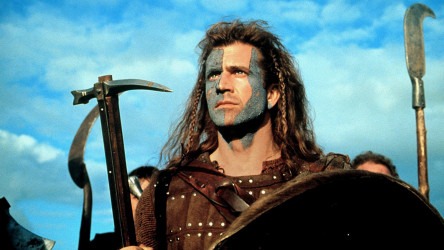
The exterior of Frankenstin's lab is a CGI fabrication — but looks almost identical to the William Wallace monument in Scotland.

After the monster escapes from the lab, he wanders on a field covered with dead soldiers from a recent battle. He is spotted by two hunters who immediately start shooting at him. Del Toro is obviously trying to show that humanity intrinsically hates those who are "different". But anyone who saw someone covered with scars staggering across a battlefield would just assume it was a surviving soldier (and probably try to
help him!). The film also makes tiresome, heavy-handed statements about capitalism and war profiteering.
Del Toro omits the subplot where Frankenstein agrees to creates a companion for the monster (then destroys her). The film feels a bit empty without this plot thread.
In this version, the monster does not murder Elizabeth. Instead Frankenstein accidentally shoots her after she professes her love for the monster.
Kenneth Branagh was roundly criticized for "bookending" his
Frankenstein movie with the plot device of the ship stuck in the arctic ocean -- but Del Toro cribs this same bookending device from Branagh's movie. And again, it proves an irrelevant tangent.
In this version, the monster heals from every wound instantaneously, and it is essentially unkillable. I honestly wondered for a few moments if Del Toro was going to provide a twist ending with a title card that tells us "The Monster lived on for centuries, and later changed his name to Logan, and joined the X-Men."
There are moments that are unintentionally funny, as when the monster finds a skull and and picks it up to look at it. I half expected him to say "Yorick, I knew him well".

The art direction is terrific, and the sets very impressive to behold -- but much of the film is lit with green light, which gets tedious to look at. Alexandre Desplat's score frequently has no relationship to the drama onscreen. The sequence where Frankenstein is constructing his lab and preparing for all manner of unnatural experiments is scored with a tuneful, euphoric waltz.
The film is never quite boring, but it often feels padded, and many scenes linger beyond their welcome. It could have been trimmed by 15 minutes.
For an over 200-year-old book that continues to have such an impact on popular culture, it's astonishing how many of its celluloid adaptations have been no more than perfunctory. At this point there are still only two genuinely great Frankenstein movies-- James Whale's
The Bride of Frankenstein, and, quite honestly, Mel Brooks'
Young Frankenstein. Even 1985's
The Bride offered a much-more believable (and compelling) portrayal of the Frankenstein and monster character arcs than this new version.
It's ironic that the first
Frankenstein film ever nominated for a Best Picture Oscar is one of the least-remarkable. Del Toro is a terrific filmmaker, but his forté is pulpy stuff -- like
Hellboy. Other than
Pan's Labyrinth, his attempts at "art films" (
The Shape of Water, Crimson Peak and now
Frankenstein) have been at best noble failures. Guillermo, just go back and make
Hellboy III, please!