
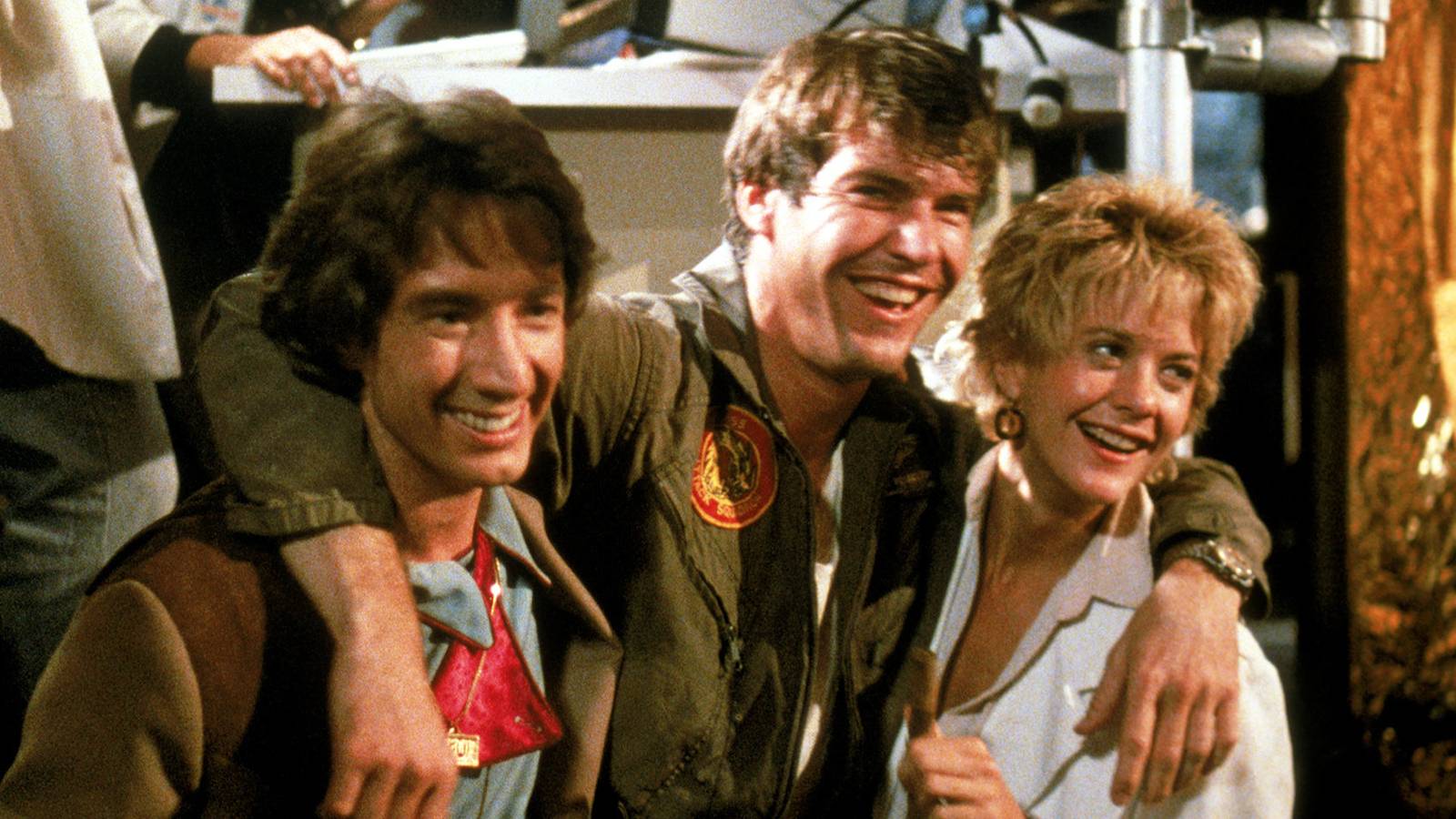
There were a number of hits in the Summer of 1987 – Paramount’s “Beverly Hills Cop II” and “The Untouchables”; Warner’s “Witches of Eastwick”; Universal’s “Dragnet”; Fox’s “Predator”; Orion’s “Robocop” and MGM/UA’s James Bond entry, “The Living Daylights,” all competed strongly at the box-office. There were also a number of sleeper hits (“Can’t Buy Me Love,” “La Bamba,” “Stakeout,” “Adventures in Babysitting”) and one mammoth late-season surprise blockbuster in “Dirty Dancing.” Of course, there were also some casualties – two of which, “Harry and the Hendersons” and INNERSPACE (119 mins., 1987, PG; Arrow) – were produced by Steven Spielberg, who ultimately generated more commercial disappointments under his Amblin production banner than smash successes.
It didn’t start out that way, of course, for movies branded with “Steven Spielberg Presents”: “Gremlins” and “Back to the Future” had been huge hits back-to-back in the summers of 1984 and 85, respectively, yet Spielberg’s midas touch took on some water with the merely-okay performance of “The Goonies” (a movie that did well, but was expected to be much bigger than it was) in Summer ‘85 and outright failure of “Young Sherlock Holmes” at Paramount during Christmas later on that same year.
Spielberg responded with two Amblin films in theaters during summer ‘87: Universal’s Bigfoot fantasy “Harry and the Hendersons,” directed by William Dear, and “Innerspace,” a big-budget Warner Bros. effort that reunited Spielberg with Joe Dante and much of his “Gremlins” crew. In the end, both movies barely generated $26 million each domestically, ranking as certified underachievers – particularly in the case of “Innerspace,” which Time’s Richard Corliss heralded as the best movie of the summer, and which had been projected to be one of the biggest pictures of the entire year.
In “Innerspace,” Dennis Quaid plays a Navy pilot who takes a gig at a top-secret laboratory where scientists have devised a miniaturization plan that will send Quaid’s Tuck Pendleton into a lab rabbit. A competing group of nefarious scientists, however (including Kevin McCarthy and Fiona Lewis), have other plans, which forces a dying colleague of Tuck’s to inject him (and his minuscule capsule) into the body of an unwitting grocery store clerk named Jack Putter (Martin Short), who is able to hear Tuck but has to tap deep to find a heroic streak that will save his life.
Dante’s film is a thoroughly likeable movie, no question, but having seen it a few times over the years, each viewing tends to reveal more of its shortcomings, which is mainly that it’s overstuffed to the point where it never quite finds a comfortable rhythm.
The script by Jeffrey Boam (“Indiana Jones & The Last Crusade,” “Lethal Weapon 2″) and Chip Proser (whose only other major credit was work on the 1984 Timothy Hutton picture “Iceman”) tries to be so many different things – a “Fantastic Voyage”-like science-fiction fantasy; madcap comedy; tech thriller; romantic comedy; and a vehicle to launch comedian Martin Short’s career in features – that it never fully satisfies in any one of those individual components. There are some effective ILM effects, but the picture never really ulitizes them – or the gimmick of Tuck being able to “guide”/”control” Jack – to an engaging degree. Meg Ryan appears as Tuck’s love interest, but outside of the duo sharing a scene at the beginning of the picture, the audience doesn’t feel any connection between them, lowering the overall dramatic stakes. McCarthy and Lewis’ villainy – as well as Vernon Wells’ Arnold-esque, sunglass-wearing, one-armed henchman – is too lightweight as well, and there’s just too much of them – and not enough of the Quaid/Short dynamic – at times.
Short certainly generates some laughs here and there, even in moments (like a Sam Cooke dancing bit) that strain to play off his talents. Obviously intended to launch the former SCTV/SNL star’s big-screen career, “Innerspace” later makes an inexplicable decision to spend an inordinate amount of time with a character named “The Cowboy” just as the movie seems to be building up a head of steam. Played by Robert Picardo, this would-be Casanova is seduced by Ryan in a sequence that seems to go on forever, culminating in a Rob Bottin face-shifting special effect that’s a precursor to his work on “Total Recall.” Sadly, this bit also takes Short off-screen and grinds the movie to a halt – prolonging its already bulging two-hour running time.
There’s also the issue of multiple endings, chase sequences, villains being shrunk – all of it wrapped up in a light, frothy Dante brew with appearances from his repertory company (in addition to Picardo, Wendy Schaal, William Schallert, Henry Gibson, Dick Miller, and Kenneth Tobey also appear), but it needed a rewrite or two to pare the material down, and there’s just no center holding it all together.
That issue is likely one of the reasons Jerry Goldsmith’s score never lands on a central, memorable theme that grabs us: Goldsmith’s music effectively runs under the FX sequences (much like his evocative underscoring for “Star Trek: The Motion Picture”) and nobly underscores Tuck’s character, but curiously fails to generate a real musical hook for listeners to latch onto. The use of pop tunes, particularly at the end with Rod Stewart’s cover of Sam Cooke’s “Twistin’ the Night Away,” likely didn’t help either.
“Innerspace” was a movie I first saw in the summer before entering 7th grade, and I recall liking it but being mildly underwhelmed. As the years passed it was never a film I had much of a desire to see again, quite unlike Dante’s other films which I grew up on.
Arrow’s limited-edition 4K UHD (1.85) presents a terrific new transfer with Dolby Vision HDR, restored from the original 35mm negative. The image, as you’d anticipate, offers a more natural and expanded color pallet over the older Blu-Ray with better resolved grain and detail as a result. Three different audio options include the original 70mm 6-track mix in a 4.1 DTS MA container, along with 2.0 DTS MA stereo and a new Dolby Atmos remix.
The release offers a number of newly produced extra features which lean heavily on the VFX side. These are highlighted by an hour-long doc “Shrinkage: The Making of ‘Innerspace’” which includes comments from Joe Dante and his long-time producer Michael Finnell, plus ILM vets Dennis Muren, Harley Jessup and Bill George, along with Robert Picardo. Though unsurprisingly devoted to mostly dissecting ILM’s Oscar-winning effects, the doc does include some candid comments about the movie’s disastrous box-office returns: Dante blames the studio for what he calls the “worst” movie advertising campaign of all-time, relaying that they thought the film – which played great in test screenings – would sell itself, and didn’t. Finnell, on the other hand, thinks the movie’s title alone was a disaster and prevented the film from finding an audience until it debuted on home video.
Other goodies include video tape archives of Dante’s on-set camcorder recordings plus a separate ILM video archive, both of which provide a candid, “you are there”-type look behind the scenes. Polaroids, still galleries, the trailer, the DVD commentary with Dante and friends, and a new commentary by Drew McWeeny are also included, along with a fold-out poster, Arrow’s customary hardbound packaging, and booklet notes featuring writing by Charlie Brigden, Michael Doyle, Josh Nelson, Jessica Scott, and Andrea Subissati.
In attempting to juggle so many different elements, the amiable “Innerspace” nevertheless proves to be less than sum of its parts – but it’s still a fun ride while it lasts, and packs, as Dennis Muren notes here, some great individual moments along the way.